How AI Is Transforming Digital Marketing in 2025
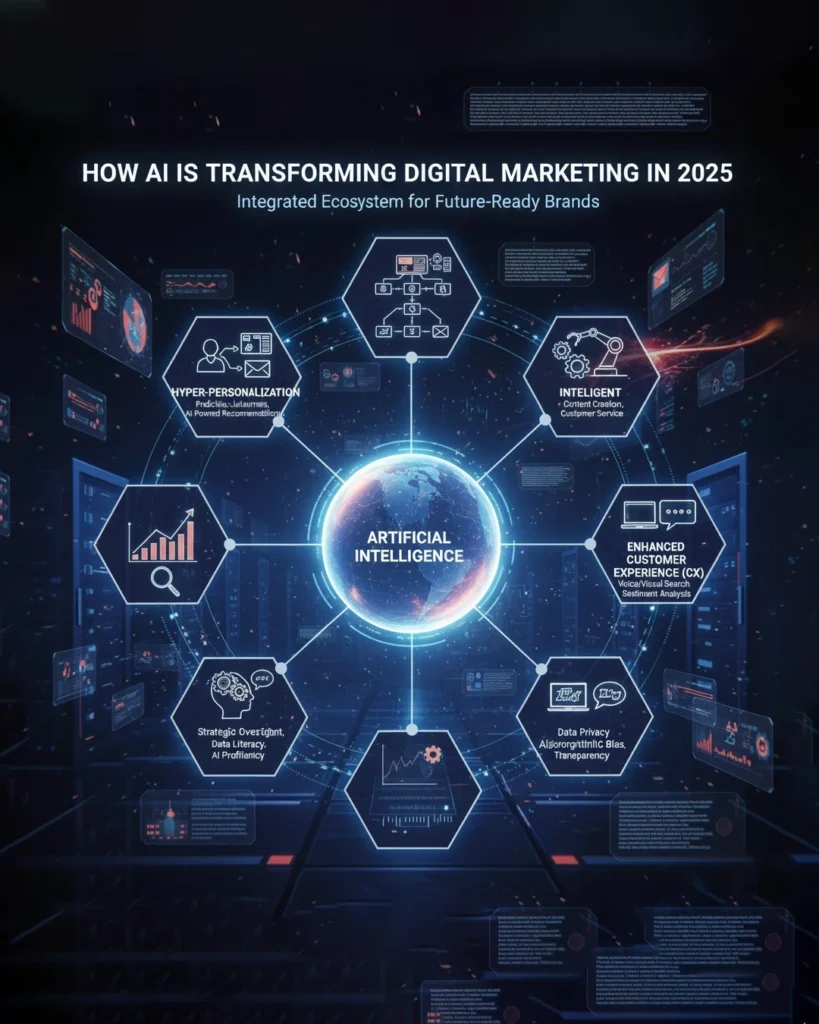
Artificial Intelligence (AI) has moved beyond being a buzzword; it has become the core of modern marketing strategies in 2025. From content creation to customer insights, AI is changing how brands connect with audiences, analyze behavior, and deliver personalized experiences. What once seemed futuristic is now essential to every successful digital marketing campaign. As businesses vie for attention in a crowded digital landscape, AI has become a crucial tool for marketers to stay ahead.
The Rise of AI in Marketing
In the past decade, marketing has shifted from relying on intuition to using data-driven strategies. AI has sped up this change by helping marketers analyze large datasets in real time and uncover insights that were difficult to detect before. In 2025, nearly every digital marketing platform, from Google Ads to Meta Business Suite and smaller analytics tools, uses AI to improve performance and efficiency. Machine learning algorithms enable brands to understand user intent, predict customer behavior, and deliver the right message to the right person at the right time.
AI is particularly revolutionary because it can adapt. It becomes smarter as it processes more data. Marketers no longer have to depend solely on guesswork or manual analysis. Instead, AI learns from patterns in user behavior, automatically improving campaign results. This ability to learn, adapt, and optimize has made AI essential in today’s digital marketing landscape.
AI and Personalization: The Power of Relevance
In 2025, personalization is the heart of digital marketing, and AI makes it possible. Traditional methods of segmenting customers by age or location are no longer sufficient. Today, AI can analyze a user’s browsing history, purchase behavior, and even emotional tone from online interactions to deliver hyper-personalized messages.
For example, AI-driven platforms like HubSpot, Salesforce Einstein, and Adobe Sensei can recommend specific products, create tailored email subject lines, and adjust ad visuals based on individual preferences. This one-to-one marketing is much more engaging than generic advertising because it directly addresses consumers’ interests. As a result, conversion rates are higher, and customer relationships are stronger.
Personalization also goes beyond sales and promotions. AI tools assist brands in creating customized website experiences where layouts, call-to-action buttons, and even page colors can change based on user data. This level of precision ensures that every visitor gets a relevant and memorable digital experience, which is essential in a world of shorter attention spans.
AI-Powered Content Creation
One of the most significant breakthroughs in digital marketing is AI’s ability to generate high-quality content. In the past, producing consistent, engaging content was a major challenge for marketers. Now, with AI writing and design tools, content production is faster, smarter, and more creative.
Platforms like ChatGPT, Jasper, Copy.ai, and Writesonic allow marketers to produce blog posts, ad copy, social media captions, and even video scripts in just minutes. These tools don’t simply generate random text; they use natural language processing (NLP) to understand tone, intent, and audience preferences, ensuring the content feels human and fits the brand.
AI-powered design platforms like Canva Magic Studio and Adobe Firefly can also create social media graphics, banners, and ad visuals with just a few prompts. This allows marketers to focus more on strategy and storytelling while AI manages repetitive creative tasks. By 2025, AI-generated content has become so seamless that most audiences can’t distinguish between human-made and AI-assisted material.
Predictive Analytics: Seeing the Future Before It Happens
Predictive analytics is one of AI’s most valuable contributions to digital marketing. By reviewing past data, AI can forecast future trends, consumer behavior, and market shifts. This predictive ability helps marketers make smarter decisions, manage budgets effectively, and anticipate customer needs even before they are expressed.
For instance, e-commerce brands use predictive analytics to identify when a customer is likely to make their next purchase, allowing them to send timely offers or product recommendations. AI can also predict which marketing channels will yield the highest ROI, helping businesses optimize their ad spending.
In 2025, predictive AI tools are integrated into most analytics dashboards. They not only show current trends but also predict what is likely to happen next. This insight-driven approach gives brands a significant competitive edge, allowing them to act proactively rather than reactively.
Chatbots and Conversational Marketing
Customer service has changed dramatically due to AI-powered chatbots. In 2025, chatbots have advanced from basic question-answer systems into intelligent virtual assistants that can handle complex interactions. These bots can process natural language, understand context, and detect emotions, leading to smoother, more human-like conversations.
Brands across various industries use AI chatbots on websites, WhatsApp, and social media to provide 24/7 support. This not only saves time and costs but also ensures that no customer query goes unanswered. AI-powered conversational marketing extends beyond customer service; it helps capture leads, qualify prospects, and guide users through the sales funnel.
For example, an AI chatbot can greet a website visitor, quickly assess their needs through questions, and recommend products or services instantly. It can also follow up with personalized messages later, improving customer engagement and conversion rates. In 2025, customers expect instant, intelligent communication, and AI meets that expectation effortlessly.
AI in Advertising and Campaign Optimization
Digital advertising has greatly benefited from AI innovation. Platforms like Google Ads and Meta Ads now rely heavily on AI to manage bidding strategies, select audience segments, and optimize ad creatives automatically. AI systems continuously monitor campaign performance and make real-time adjustments to ensure the best possible ROI.
AI also plays a crucial role in creative testing. With tools like Dynamic Creative Optimization (DCO), brands can automatically test multiple ad variations and discover which combinations perform best for different audiences. This automation enables marketers to achieve better results with less manual effort.
Additionally, AI-driven programmatic advertising ensures that ads reach the right audience at the right time. The system evaluates billions of data points, including demographics, behavior, location, and device type, to serve personalized ads with great accuracy. As a result, advertising campaigns in 2025 are smarter, faster, and more cost-effective than ever.
AI and SEO: Smarter Search Strategies
Search engine optimization has also changed thanks to AI. Tools like Surfer SEO, Clearscope, and MarketMuse use AI to analyze search intent, suggest topic clusters, and optimize content structure. Search engines such as Google’s AI-powered “Search Generative Experience (SGE)” now focus on understanding natural language and delivering more contextual results.
This means that marketers can no longer rely on keyword stuffing or outdated SEO techniques. They must create genuinely helpful content that aligns with user intent, something AI tools can now identify accurately. AI also aids in voice search optimization, which continues to grow as voice assistants like Alexa, Siri, and Google Assistant become more integrated into daily life.
By using AI-driven SEO tools, businesses can better understand what their audience is searching for, how they phrase queries, and what kind of content meets their needs. This deeper understanding leads to higher visibility, better engagement, and stronger organic growth.
Ethical Considerations and the Human Touch
Despite its power, AI raises ethical challenges. In 2025, marketers face new questions about data privacy, authenticity, and transparency. AI can generate highly realistic content, but it can also blur the line between what is real and what is machine-made. Maintaining honesty and human oversight is essential for building trust with audiences.
Moreover, while AI can efficiently handle data and automation, creativity and emotional storytelling still need a human touch. The best digital marketing strategies in 2025 will blend AI’s analytical power with human creativity. AI should be viewed as a partner, not a replacement; a tool that enhances human abilities rather than takes their place.
The Future of AI in Digital Marketing
Looking forward, the bond between AI and marketing will only grow stronger. Future advancements will likely include even more sophisticated predictive models, emotional AI that can interpret human sentiment with greater accuracy, and completely automated marketing systems that need minimal manual input.
However, the most successful marketers will know how to balance technology with authenticity. The skills to tell stories, understand audience emotions, and create meaningful connections will remain irreplaceable even in an AI-driven world.
As we advance further into the age of intelligent marketing, one thing is clear: AI is not just changing how we market; it’s redefining what marketing means. It’s reshaping creativity, efficiency, and customer experience. In 2025, the blend of human insight and artificial intelligence is creating a new era of digital marketing that is smarter, more responsive, and immensely more powerful.